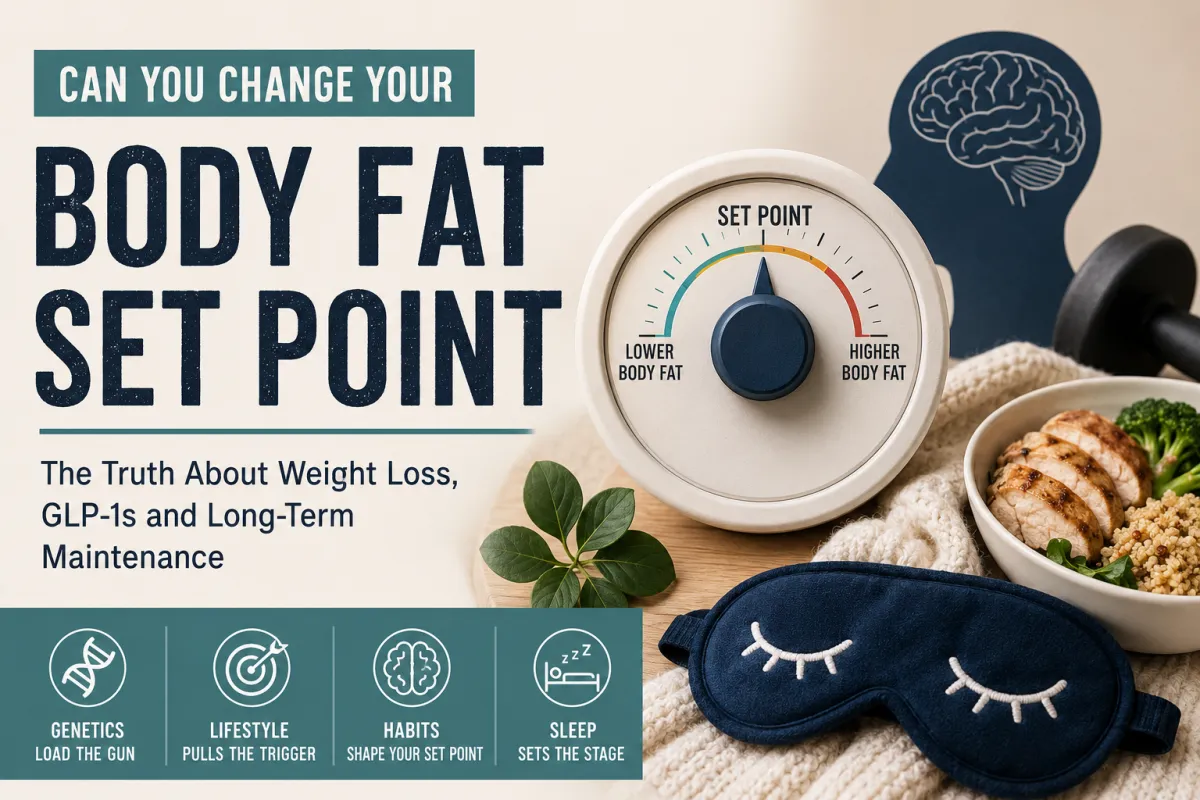
Can You Change Your Body Fat Set Point? The Truth About Weight Loss, GLP-1s and Long-Term Maintenance
If you’ve spent any time listening to weigh loss podcasts, reading weight books, or following the latest conversations around weight loss, you’ve probably heard the term “body fat set point” or “weight set point.”
Some experts describe it as your body’s internal thermostat or a weight range your body naturally wants to maintain.
More recently, with the rise of medications like Ozempic and Wegovy, some people have suggested that GLP-1 medications are the only way to permanently lower this set point.
But is that actually what the evidence shows?
The short answer is: No - GLP-1s are NOT the only way to permanently lower your body fat set point.
The science tells a much more nuanced story.
So if you’ve ever wondered:
Why do I regain weight after dieting?
Can you change your body fat set point? If so, how?
Do GLP-1 medications permanently reset your metabolism?
Why does weight loss get harder over time?
How do some people maintain weight loss for years?
You’re not alone.
These are some of the most commonly searched weight loss questions online, and understanding the answers can help you build a more sustainable approach to fat loss and long-term weight maintenance.
⸻
What Is a Body Fat Set Point?
The set point theory suggests that our bodies have biological mechanisms designed to regulate body weight.
When we lose weight, the body often responds by:
Increasing hunger
Increasing food cravings
Reducing satiety signals
Lowering energy expenditure
Encouraging us to move less without realising it
From an evolutionary perspective, this makes sense. For most of human history, food scarcity was a bigger threat than food abundance.
Your body doesn’t know you’re trying to fit into a smaller pair of jeans. It simply sees weight loss as a potential threat to survival.
This is one reason why maintaining weight loss can often feel harder than losing it in the first place.
⸻
Why Many Researchers Now Prefer the “Settling Point” Theory
While biology clearly plays a role, many obesity researchers now believe body weight is better explained by what’s called the settling point theory.
Instead of having a single fixed weight that your body will always defend, your body weight “settles” where biology, environment, habits and lifestyle consistently place it.
Think about it this way:
Genetics = influence appetite, hunger and food preferences.
Our environment = influences how much food is available.
Our habits = influence how active we are.
Our sleep, stress levels and routines = affect our food choices.
Our muscle mass = influences energy expenditure.
Our food environment = influences how easy it is to overconsume calories.
All of these factors interact to determine where your body weight ultimately settles.
In other words:
Your weight is influenced by biology, but it is not permanently fixed.
⸻
Why Weight Loss Often Feels So Difficult
One of the most famous studies on this topic followed contestants from The Biggest Loser.
Researchers found that many participants experienced significant metabolic adaptation after extreme weight loss. Their bodies became more efficient, making weight maintenance harder.
This doesn’t mean weight loss is impossible.
It means that aggressive dieting often comes with aggressive biological pushback.
This is one reason why crash diets, detoxes, meal replacement plans and “all-or-nothing” approaches rarely produce lasting results.
⸻
So Can You Change Your Body Fat Set Point?
The million dollar question!
The evidence suggests that while your body may initially resist weight loss, it can gradually adapt to a lower body weight over time.
The key isn’t finding a magic hack.
The key is creating a lifestyle that your body can realistically maintain.
Research on successful long-term weight loss maintainers consistently finds similar habits:
Regular physical activity
Resistance training
Higher protein intake
Consistent eating patterns
Self-monitoring
Sustainable calorie deficits
Maintenance phases between dieting periods
Long-term lifestyle consistency
Notice what’s missing from that list?
Perfection!!
The people who maintain weight loss long term aren’t perfect. They’re simply consistent.
⸻
The Importance of Maintenance Phases
One mistake many people make is thinking that once they reach their goal weight, the job is done.
In reality, maintenance may be the most important and hardest phase of all.
Research suggests that spending time maintaining your weight after a fat loss phase may help reduce some of the body’s compensatory responses to dieting.
This is one reason we often encourage our clients to think beyond the next 8–12 weeks and focus on what they can sustain for years.
The goal isn’t simply to lose weight.
The goal is to learn how to live at that new weight.
That's where the real work lies and something we are very passionate about teaching & guiding all our clients through.
⸻
What About GLP-1 Medications Like Ozempic and Wegovy?
GLP-1 medications such as Ozempic and Wegovy can be incredibly effective tools for the right people, under the right circumstances and with an educated and informed choice.
They work largely by:
Reducing hunger
Increasing fullness
Reducing food noise
Helping people maintain a calorie deficit
For many individuals, particularly those living with obesity and/or debilitating food noise, these medications can be life-changing.
However, it’s important to understand what the research actually shows.
In studies where participants stopped taking semaglutide, much of the lost weight was regained over time.
This suggests that GLP-1 medications help manage the biological drivers of weight regain while they are being used, rather than permanently switching them off forever.
That doesn’t make them ineffective.
It simply means they are a tool - not a cure.
⸻
What We Believe & Preach at Strong Fams
At Strong Fams, we don’t believe your body is broken.
We don’t believe you’re doomed by your genetics.
And we don’t believe you need to rely on extremes to achieve lasting results.
We do believe that:
Biology matters.
Genetics matter.
Hormones matter.
Environment matters.
Lifestyle matters.
But we also believe that sustainable habits & education matter.
The goal isn’t to fight your body.
The goal is to work with it.
Building muscle, increasing daily movement, prioritising protein, improving sleep, managing stress and maintaining a healthy body weight for long periods of time all help create a new normal that your body can comfortably maintain.
⸻
The Bottom Line
Your body may defend a higher weight.
That defence is real.
But it isn’t necessarily permanent.
The evidence suggests that while weight loss triggers biological resistance, long-term behaviour change, regular exercise, resistance training, adequate protein, maintenance phases and a supportive environment can all help shift where your body weight settles over time.
GLP-1 medications can be a valuable tool for some people.
But they are not the only path to long-term success.
At the end of the day, lasting results come from creating a lifestyle that you can realistically enjoy, sustain and repeat for years - not weeks.
Because the goal isn’t simply to lose weight.
The goal is to create a life where maintaining that weight feels normal.
⸻
Looking for Sustainable Weight Loss Support?
If you're ready to move beyond diets and build a healthier lifestyle you can actually maintain, Strong Fams is here to help.
Explore our website for more evidence-based articles, practical resources and coaching designed to help you create lasting results.
Ready to get started? Visit our Services page or Contact us today.
⸻
References
Klem ML, Wing RR, McGuire MT, Seagle HM, Hill JO. A Descriptive Study of Individuals Successful at Long-Term Maintenance of Substantial Weight Loss. American Journal of Clinical Nutrition. 1997. Available at: https://pubmed.ncbi.nlm.nih.gov/9250100/
Wing RR, Hill JO. Long-Term Weight Loss Maintenance. American Journal of Clinical Nutrition. 2005. Available at: https://pubmed.ncbi.nlm.nih.gov/16002825/
Hill JO, Wing RR. The National Weight Control Registry: Is it Useful in Helping Deal with Our Obesity Epidemic? Journal of Nutrition Education and Behavior. 2005. Available at: https://pubmed.ncbi.nlm.nih.gov/16029692/
Thomas JG, Bond DS, Phelan S, Hill JO, Wing RR. Weight-Loss Maintenance for 10 Years in the National Weight Control Registry. American Journal of Preventive Medicine. 2014. Available at: https://pubmed.ncbi.nlm.nih.gov/24355667/
Speakman JR, Levitsky DA, Allison DB, et al. Set Points, Settling Points and Some Alternative Models: Theoretical Options to Understand How Genes and Environments Combine to Regulate Body Adiposity. Available at: https://pmc.ncbi.nlm.nih.gov/articles/PMC2990627/
Byrne NM, Sainsbury A, King NA, et al. Intermittent Energy Restriction Improves Weight Loss Efficiency in Obese Men: The MATADOR Study. International Journal of Obesity. 2018. Available at: https://pubmed.ncbi.nlm.nih.gov/28925405/
Fothergill E, Guo J, Howard L, et al. Persistent Metabolic Adaptation 6 Years After The Biggest Loser Competition. Obesity. 2016. Available at: https://pmc.ncbi.nlm.nih.gov/articles/PMC4989512/
Paixão C, Dias CM, Jorge R, et al. Successful Weight Loss Maintenance: A Systematic Review of Weight Control Registries. Obesity Reviews. 2020. Available at: https://pmc.ncbi.nlm.nih.gov/articles/PMC9105823/
Wilding JPH, Batterham RL, Davies M, et al. Weight Regain and Cardiometabolic Effects After Withdrawal of Semaglutide: The STEP 1 Trial Extension. Diabetes, Obesity and Metabolism. 2022. Available at: https://pubmed.ncbi.nlm.nih.gov/35441470/